El-Sayed’s win and the politics they tried to bury
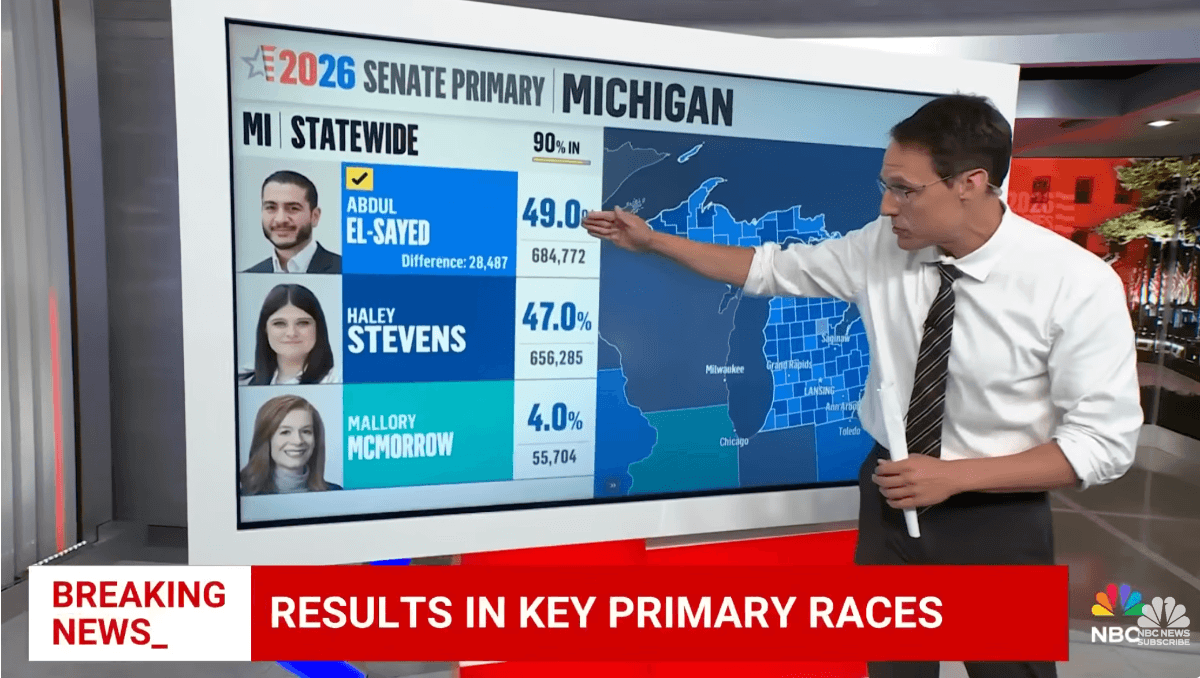
Screenshot from MS NOW, Aug. 5, 2026.
WHEN DISSENT BECOMES POLITICAL POWER
Just two years ago, the student encampments that formed across the country to protest U.S. support for Israel’s mass killing of civilians in Gaza were treated as a threat.
Yesterday, Michigan’s Democratic primary told a very different story.
Dr. Abdul El-Sayed, an unapologetic advocate for Palestinian rights and an outspoken critic of Israel’s war crimes and U.S. militarism, won a decisive victory in one of the most closely watched Senate primaries in the country despite AIPAC and allied pro-Israel groups pouring more than $30 million into the race to defeat him, part of a broader pro-Stevens outside-spending blitz that reportedly topped $60 million.
El-Sayed’s victory is just the latest sign of a political shift that’s been building since the earliest months of Israel’s assault on Gaza, as polls now show growing numbers of Americans across party lines rejecting not only the old consensus on Israel, but also the billionaire-funded, corporate-backed machinery that polices the boundaries of acceptable debate on U.S. foreign policy and perpetual war.¹
That’s why the acclaimed documentary The Encampments feels so essential right now: it provides an immersive look at one of the defining flashpoints in the struggle over Gaza, U.S. militarism, and the limits of free speech and dissent.
LEARN MORE ABOUT THE FILM
The Encampments takes viewers inside the Columbia University pro-Palestinian student encampments as they unfolded in real time, following Palestinian and Jewish students as they organized in solidarity, challenged institutional power, and faced intense backlash from university leaders, political leaders in both parties, and mainstream media, where they were repeatedly cast as dangerous, extreme, naïve, antisemitic, and politically radioactive.
The film’s focus on how legitimate forms of dissent can be pathologized feels especially urgent now as the Trump administration and State Department² — with help from some Democrats³ — move to revive a McCarthyite politics of suspicion, casting left-wing critics of U.S. foreign policy, Palestinian rights advocates, and antiwar voices as extremist, terrorist-aligned, or anti-American.
The Encampments opens space for educators and students to engage these issues and have critical conversations about free speech, media framing, academic freedom, war, political repression, generational change, and the role of dissent in democratic life.
The Encampments is now available on our streaming platform in multiple formats. It’s also available as part of MEF’s Premium Collection, which offers flexible subscription and permanent-access licensing options. To learn more about the Premium Collection, contact Stephen Belcourt at [email protected].
1. “The pro-Israel political consensus is collapsing in both parties,” by Isaac Arnsdorf, Washington Post, May 6, 2026, and “Just one in three Americans backs Iran war, most unsure of Trump’s goals, poll finds,” by Bo Erickson and Jason Lange, Military Times, July 31, 2026.2. “After ‘Political Terrorism’ Summit, U.S. Names 43 Americans + Groups,” by Ken Klippenstein, Substack, July 20, 2026.3. “Never-El-Sayed moment in Michigan?,” by Nicholas Wu, Semafor, July 30, 2026.
PRAISE FOR THE ENCAMPMENTS
“The Encampments blew me away. One of the best docs I’ve seen in years.”
— Michael Moore, Filmmaker
“Indelible … Mahmoud Khalil is the bridge through which the film makes its arguments about the hypocrisy of élite liberal education, which feeds on ideals of free inquiry and free speech and abdicates its responsibility in freeing people.”
— The New Yorker
“The Encampments lays bare what’s at stake: whether higher education will defend democratic principles or bow to authoritarian pressure at a moment when free speech on campus is under assault.”
— Sut Jhally | Professor Emeritus, UMass-Amherst & MEF Executive Director
“Gripping … That the use of a militarized police force on protesters has become so commonplace in the last decade should concern all Americans, especially as the Trump administration continues to act in ways that violate protected rights. The Encampments is not just critical in capturing the real-time makings of a movement, but in laying bare the consequences of this response.”
— The Hollywood Reporter
“Stirring and tense … a rousing documentary. The strength of the film is that it avoids getting caught up in polemics, instead focusing solely on the encampments and the people who led them … young, educated people [who] do not want to pay for the killing of Palestinians. The administration, however, is compromised: how can they agree to divest from companies whose representatives serve on the university board?”
— Sight & Sound
“The Encampments does a masterful job showing the full story of the Columbia encampment and the activism that preceded it. … [It] leaves viewers empowered — a welcome feeling as we witness the horrific and endless butchering of civilians and destruction of homes in Gaza.”
— Mondoweiss
“An urgent protest film that carries the same conviction and resolve of the students who organized these demonstrations … As a snapshot of a particular few weeks in which a protest movement was born and spread, it’s an effective and prescient documentary.”
— Variety
“Necessary and urgent … A considered rejoinder to the hysterical mischaracterizations of the encampments as ridden with ‘radical,’ ‘extremist’ and ‘antisemitic’ elements.”
— Middle East Eye
“Immersive … One of the most important elements of the movie is its debunking of the public narrative about the actions and motivations of the protesters. … Far from divisive, it’s an inspiration to behold.”
— KQED, San Francisco, CA
“Rousing and reflective … artistically triumphant. … Not only is The Encampments keenly observational about the kind of detail and planning that goes into such movements, it also makes for an intimate aesthetic embodiment of what participating in a protest feels like, in all its hues.”
— IndieWire
“Offers undeniable food for thought.”
— The Times of London