Different problems. One underlying story.

Different crises. Same doctrine.
Rising housing costs. Stagnant wages. Job insecurity. Unaffordable healthcare. The unchecked spread of AI. Corporate monopolies. Billionaire power. Climate breakdown. Endless war. Declining trust in political institutions.
Students encounter these problems every day in their own lives and through a media culture that tends to present each one in isolation, with its own causes and solutions.
But what if these problems aren’t separate at all, but expressions of the same political and economic order?
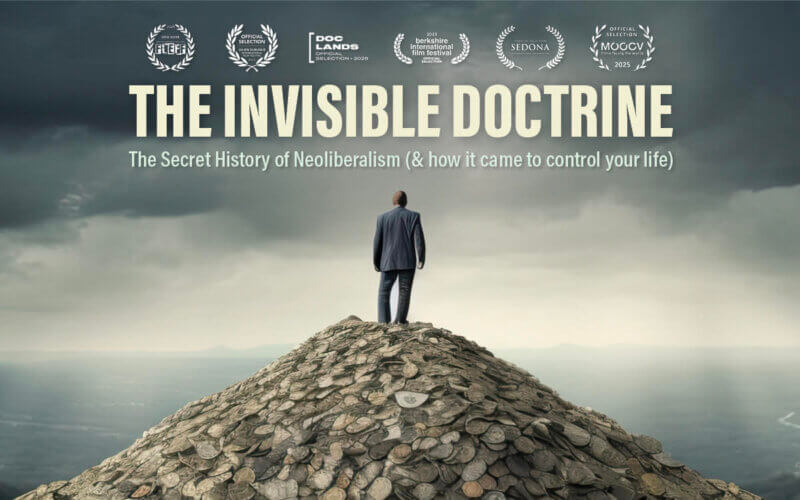
That’s the provocative argument at the heart of The Invisible Doctrine: The Secret History of Neoliberalism (and How It Came to Control Your Life), featuring acclaimed journalist and activist George Monbiot.
Directed by Peter Hutchison and Lucas Sabean, The Invisible Doctrine offers something increasingly rare: a clear definition and history of neoliberalism, a business-backed ideology that has come to dominate our political and social lives through its relentless drive to cut taxes, weaken trade unions, gut government regulations, and privatize public services.
Just as importantly, it offers a clear and coherent framework for understanding how an ideology most people struggle even to define managed to capture both major political parties and reshape media, technology, education, healthcare, the environment, national security, and nearly every other aspect of public life.
The Invisible Doctrine is now available on MEF’s new streaming platform. It’s also available as part of the MEF Premium Collection, our institutional streaming library of documentary films for teaching and research.*
In the film, Monbiot traces neoliberalism’s rise from an obscure, fringe philosophy to the prevailing ideology of our time. Then he brings home the receipts: the corporate takeover of public institutions and services, a vast and ever-expanding military-industrial complex, soaring inequality, accelerating environmental destruction, and a political system increasingly shaped by concentrated private wealth rather than democratic priorities.
At a moment when students are questioning inherited assumptions about markets, corporate power, U.S. militarism, democracy, and the role of government, The Invisible Doctrine gives them more than a definition of neoliberalism. It helps them connect the crises they see around them to the deeper forces driving them. And it gives them the intellectual tools to imagine and debate what a more democratic future might look like.
The result is a powerful classroom resource for courses in political science, political economy, media studies, cultural studies, economics, sociology, communications, environmental studies, public policy, technology and society, globalization, corporate power, propaganda, economic inequality, and democratic institutions.
*The Invisible Doctrine is also available as part of MEF’s Premium Collection, which offers flexible subscription and permanent-access licensing options. To learn more, contact Stephen Belcourt at [email protected].
PRAISE FOR THE INVISIBLE DOCTRINE
“One of the most essential documentaries of 2025”
— Romey Norton, Film Focus Online
“Part detective story, part exorcism, The Invisible Doctrine traces how a fringe economic theory went on to infiltrate university departments, government cabinets, and the global imagination, rebranding greed as freedom and deregulation as salvation. … The film plays like an annotated roadmap through the rubble of our current moment: a democracy hobbled by corporate power, a climate in freefall, public services gutted, and an atomized citizenry rebranded as ‘consumers.’ But it’s not just a dirge. The Invisible Doctrine is also a call to remember alternatives that once existed—and still do.”
— Brian K. Mahoney, Chronogram
“An extraordinary, kinetically charged, visually stunning 75-minute documentary savagely deconstructing neoliberalism.”
— Greggory W. Morris, The WORD
“This compelling documentary highlights the role of neoliberalism undergirded by oligarchal wealth in promoting individualism and competition, and its links with emergent loneliness, alienation and right wing ethnonationalism and supremacism. At the same time, Monbiot offers a vision for an alternative that can emerge from below, one based in humane grassroots mutual aid, commoning and care. This is a must-watch for those who seek to understand and contest the current Trump-led spiral into an economic, political, cultural and environmental polycrisis.”
— Eric Sheppard, Professor at UCLA and author of The Limits to Globalization
“Monbiot boldly imagines an alternative to neoliberalism and capitalism. In these reimagined futures, viewers are asked to grapple with the role of generative AI in resisting late capitalism.”
— Caroline Alphin, Department of English at Radford University, Author of Neoliberalism and Cyberpunk Science Fiction
“[The Invisible Doctrine] offers critical insight into the causes of the political, environmental, and social crises that have come to define our times.”
— The Commons
“10/10”
— Bobby LePire, Film Threat
One of the “Best (and Most Highly Anticipated) Documentaries of 2025.”
— Erik Morse, Vogue
“Top 10 Must-Watch Documentaries of 2025.”
— Pooja Pillai, EasternEye