Who gets to define Mahmoud Khalil?
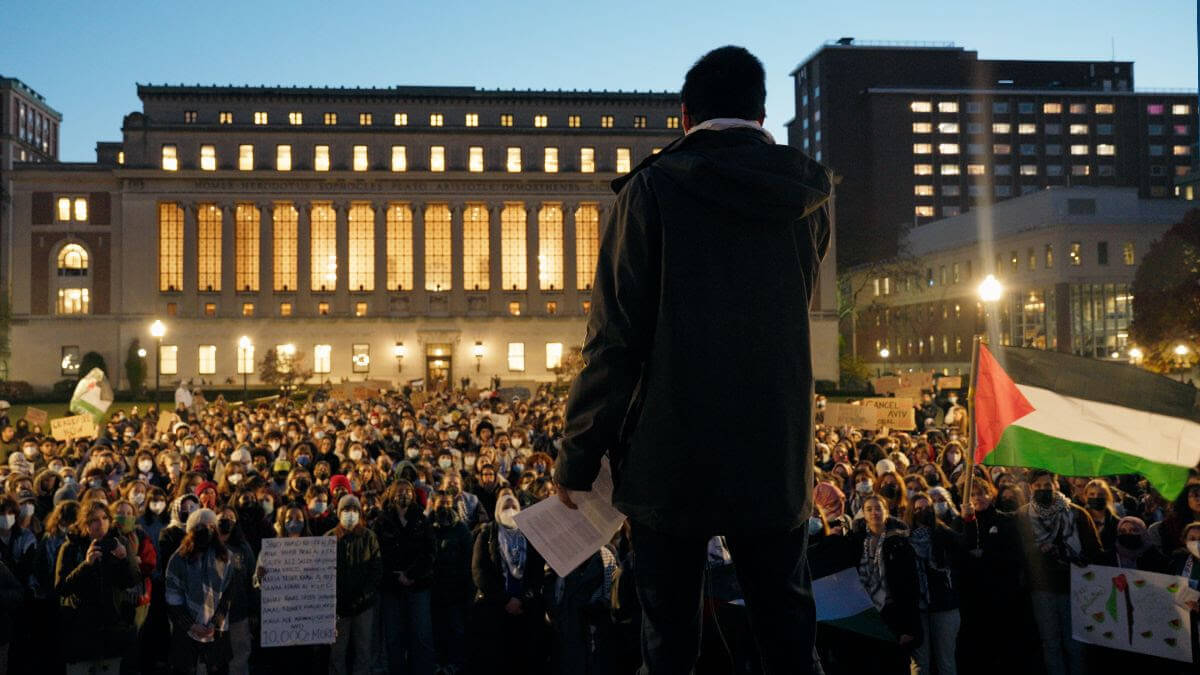
Movie still from The Encampments: Mahmoud Khalil addresses fellow pro-Palestinian protestors at Columbia University in 2024.
WHO GETS TO DEFINE MAHMOUD KHALIL?
The acclaimed documentary The Encampments brings students inside the Columbia protests still making headlines.
Mahmoud Khalil, the Palestinian graduate student who became one of the public faces of the 2024 Columbia protests opposing U.S. support for Israel’s mass killing of civilians in Gaza, is back in the news.
But the fight over what he represents is far from settled.
From the moment the Columbia student encampments became a national story, a range of politicians, media commentators, and pro-Israel advocates cast Khalil and his fellow protesters as antisemitic, terrorist-sympathizing left-wing extremists whose speech and activism posed a threat to U.S. national security.
Beyond the dominant media frame, others were telling a very different story: that Khalil and other students who joined the encampments, Palestinian and Jewish alike in solidarity, were peacefully protesting both Israel’s U.S.-backed destruction of Gaza and Columbia’s investments in companies profiting from that destruction, including the U.S. weapons manufacturers supplying the bombs.
Now, two and a half years later, Khalil and the Columbia encampments are once again at the center of a public fight over the meaning of pro-Palestinian speech and protest.
Just last month, in the same week that a New York Times review praised Khalil’s new memoir, No Land to Stand On: Notes from Detention, as “quietly shattering” and “a frightening, important book,”¹ pro-Israel activists in Massachusetts successfully pressured a theater operator to withdraw from a sold-out event for Khalil’s book.²
In that same stretch, Khalil and other pro-Palestinian students were also in the news after filing a lawsuit accusing Columbia of anti-Palestinian discrimination, retaliation, and failure to protect students from doxxing and harassment. The suit says explicitly that Columbia refused to correct disinformation about Khalil’s role and conduct while he was detained by ICE without being charged with a crime, allowing false narratives to persist as the Trump administration portrayed him as pro-Hamas and fought to deport him as a national security threat.³
For educators looking to help students make sense of this ongoing fight to define Khalil, the student protests he helped bring to national attention, and the broader pro-Palestinian and antiwar movements, the acclaimed documentary The Encampments couldn’t be a more timely and essential resource.
By taking viewers inside the Columbia student encampments as they unfolded in real time, and showing Khalil himself in action as an organizer, negotiator, and public spokesman for the movement, The Encampments gives students a chance to make up their own minds about whether political and media attacks on Khalil and the protests square with what actually happened on the ground.
In the classroom, The Encampments opens space for timely conversations about:
- rapid shifts in American public opinion on Israel, Gaza, and Palestinian rights
- continuing U.S. support for Israel’s destruction of Gaza despite these shifts
- whose humanity is centered in U.S. news media and political discourse, and whose is not
- the state of academic freedom and student activism on college campuses
- the role of dissent, free speech, and open debate in democratic societies more broadly.
The Encampments is now available in multiple formats on our new streaming platform.
It’s also available as part of our new Premium Collection, which offers flexible subscription and permanent-access licensing options. To learn more about the MEF Premium Collection, contact Stephen Belcourt at [email protected].
1. Jennifer Szalai, “A Quietly Shattering Memoir by a Man Detained by ICE for His Beliefs,” The New York Times, September 23, 2026.
2. Jessica Russak-Hoffman, “Protesters persuade theater operator to pull out of Mahmoud Khalil event,” Jewish News Syndicate, September 25, 2026.
3. “Mahmoud Khalil sues Columbia University, claims it failed to protect pro-Palestinian activists,” CBS News / Associated Press, September 15, 2026; “Trump says arrest of Palestinian activist who helped lead Columbia protests is first of ‘many to come,’” CBS News, March 10, 2025.</p.

“The Encampments blew me away. One of the best docs I’ve seen in years.”
— Michael Moore, Filmmaker
“Indelible … Mahmoud Khalil is the bridge through which the film makes its arguments about the hypocrisy of élite liberal education, which feeds on ideals of free inquiry and free speech and abdicates its responsibility in freeing people.”
— The New Yorker
“The Encampments lays bare what’s at stake: whether higher education will defend democratic principles or bow to authoritarian pressure at a moment when free speech on campus is under assault.”
— Sut Jhally | Professor Emeritus, UMass-Amherst & MEF Executive Director
“Gripping … That the use of a militarized police force on protesters has become so commonplace in the last decade should concern all Americans, especially as the Trump administration continues to act in ways that violate protected rights. The Encampments is not just critical in capturing the real-time makings of a movement, but in laying bare the consequences of this response.”
— The Hollywood Reporter
“Stirring and tense … a rousing documentary. The strength of the film is that it avoids getting caught up in polemics, instead focusing solely on the encampments and the people who led them … young, educated people [who] do not want to pay for the killing of Palestinians. The administration, however, is compromised: how can they agree to divest from companies whose representatives serve on the university board?”
— Sight & Sound
“The Encampments does a masterful job showing the full story of the Columbia encampment and the activism that preceded it. … [It] leaves viewers empowered — a welcome feeling as we witness the horrific and endless butchering of civilians and destruction of homes in Gaza.”
— Mondoweiss
“An urgent protest film that carries the same conviction and resolve of the students who organized these demonstrations … As a snapshot of a particular few weeks in which a protest movement was born and spread, it’s an effective and prescient documentary.”
— Variety
“Necessary and urgent … A considered rejoinder to the hysterical mischaracterizations of the encampments as ridden with ‘radical,’ ‘extremist’ and ‘antisemitic’ elements.”
— Middle East Eye
“Immersive … One of the most important elements of the movie is its debunking of the public narrative about the actions and motivations of the protesters. … Far from divisive, it’s an inspiration to behold.”
— KQED, San Francisco, CA
“Rousing and reflective … artistically triumphant. … Not only is The Encampments keenly observational about the kind of detail and planning that goes into such movements, it also makes for an intimate aesthetic embodiment of what participating in a protest feels like, in all its hues.”
— IndieWire
“Offers undeniable food for thought.”
— The Times of London