When Women Reporters Challenge Authority
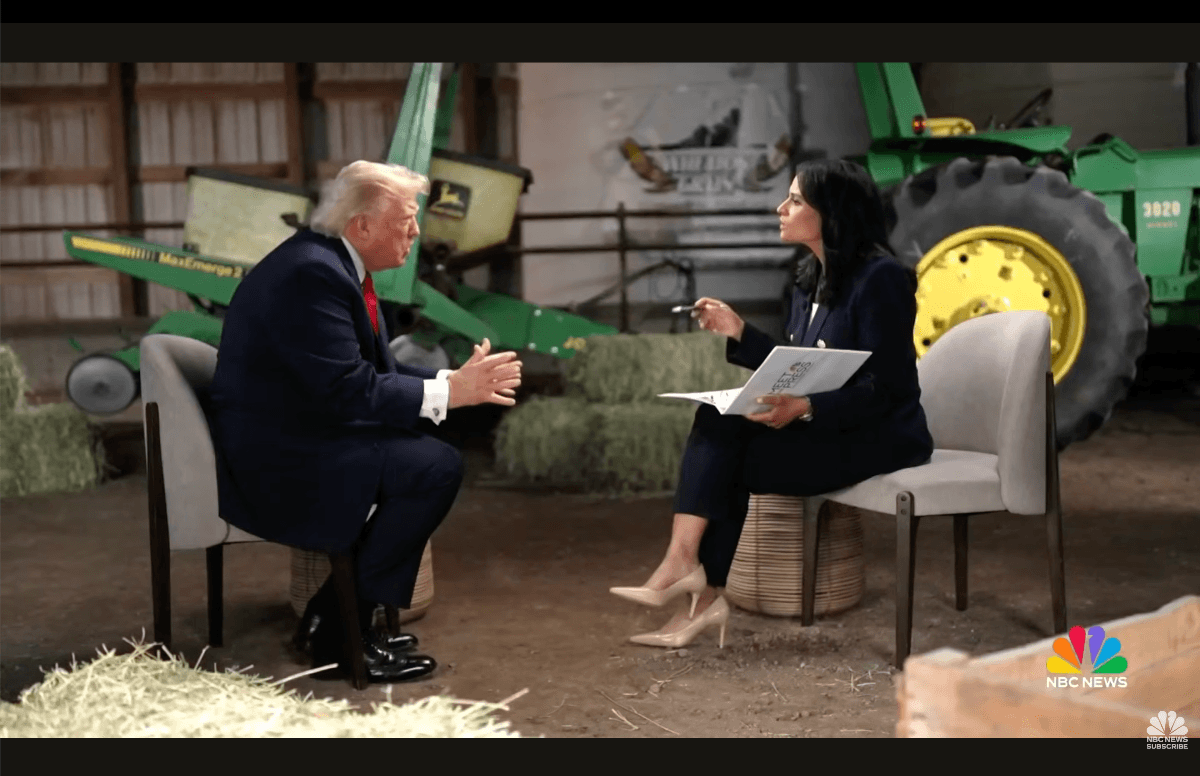
Donald Trump calls NBC reporter Kristen Welker “either crooked or stupid” moments before cutting off the interview and leaving the set during a taping of Meet the Press on June 5, 2026. (Video screenshot from NBC News YouTube channel.)
When Women Reporters Challenge Authority
A Timely New Documentary on Journalism, Gender & Power
President Trump has long responded to difficult questions by criticizing the journalists asking them. His targets have varied, but when women reporters have challenged him, he’s often gone after them personally — questioning their intelligence, mocking their demeanor, and attempting to undermine their authority in ways that go well beyond his broader hostility to the press.
His recent confrontations with prominent journalists like Kaitlan Collins, Kristen Welker, and Rachel Scott have once again drawn attention to that pattern.¹ But the story doesn’t begin or end with Donald Trump.
For generations, women — especially women of color — have had to fight not simply for a place in American newsrooms, but for the authority to decide whose stories deserve attention and which questions are worth asking. All along, that struggle has been less about representation for its own sake than about how power works to shape what counts as news.
Our acclaimed new release Breaking the News tells the story of this struggle from inside one remarkable newsroom.
Directed by award-winning filmmakers Heather Courtney, Princess A. Hairston, and Chelsea Hernandez, Breaking the News follows the launch of The 19th*, the groundbreaking independent digital newsroom founded by women in 2020 to cover the intersection of gender, politics, policy, and power. The 19th* is named for the constitutional amendment guaranteeing women’s suffrage, using an asterisk to underscore the structures of power that excluded women of color from its original promise.
Breaking the News isn’t simply about women reporters covering “women’s issues.” It’s about women—and LGBTQ—journalists trying to do their jobs as they cover politics, elections, public policy, democracy, and power. And it’s about how they do all of this while navigating deeply gendered newsroom cultures, institutional assumptions, ownership structures, and professional norms that shape what ultimately reaches the public.
For educators, Breaking the News provides the historical and institutional context students need to move beyond today’s headlines and understand the larger forces that have shaped American journalism. The result is a timely, classroom-ready resource for examining media power, gender, and democratic accountability through a wider and more critical lens.
Two versions of the film are available on our platform: the full-length 95-minute cut and a 59-minute abridged edition especially well-suited for classroom use.
Breaking the News is also available as part of the MEF Premium Collection, our institutional streaming library of documentary films for teaching and research. Flexible subscription and permanent-access licensing options are available. To learn more, contact Stephen at [email protected].
Breaking the News is ideal for courses that examine:
- Journalism, communications, and media production
- The intersection of mass media, corporate power, and commercial interests
- Political science and public policy
- Gender, sexuality, and power
- Race, power, and representation
- The history of journalism, democracy, and civic life
(1) “Trump keeps insulting female journalists. It’s time for the press to stop tolerating it,” by Margaret Sullivan, The Guardian, June 12, 2026.

PRAISE FOR BREAKING THE NEWS
“Breaking the News is a must-see documentary for anyone who works in journalism or is studying to get into the field. The 19th*’s unique rise to independent newsroom fame is one for the history books, and the experiences of the editors and journalists contained within will be endlessly valuable to people who want to make changes in the field.”
—Video Librarian
“Breaking the News is an immersive, crowd-pleasing, candid portrait of a start-up [news agency] experiencing growing pains, roadblocks, and ultimately success in changing the paradigm and business model for news. … One of those rare films that, like Citizenfour, might be seen as a major landmark in cinéma vérité documentaries about journalism.”
— The Film Stage
“The modern world can be a very depressing place at times. This film will give you hope.”
— Hammer to Nail’s “20 Most-Anticipated Films at Tribeca”
“This high-stakes documentary … looks poised to join the pantheon of great newsroom docs.”
— International Documentary Association (IDA)
“Fortuitous timing meets skilled filmmaking to create the new film Breaking the News, and with it documentary fans are in for a fascinating and compelling cinematic experience. … As historically important as the work that The 19th* has done and continues to do.”
— Alliance of Women Film Journalists (AWFJ)
“A scrappy group of women and LGBTQ+ journalists buck the white male-dominated status quo, banding together to launch The 19th*, a digital news startup aiming to combat misinformation. A story of an America in flux, and the voices often left out of the narrative, the documentary Breaking the News shows change doesn’t come easy.”
— PBS, Independent Lens
“Breaking the News is unflinching about the areas of tension within The 19th*, and presents them without direct commentary, simply letting the viewer see it all plainly. … The documentary does not paint anyone as a hero, or as a perfect representation. It shows human beings trying their best in very difficult circumstances – indeed circumstances that only seem to get worse.”
— Educational Media Reviews Online
“It’s inspiring to see passionate journalists put their livelihoods on the line – sometimes while pregnant, or parenting their children – to build a platform that will welcome future writers with open arms. Not just any writers, but individuals who will try to bring fresh perspectives into problems that affect countless people that most networks and newspapers ignore.”
— Loud & Clear
“The film scores points by giving us a wonderful selection of people to cheer for. You can’t help but like all of them. What a delight.”
— Unseen Films