



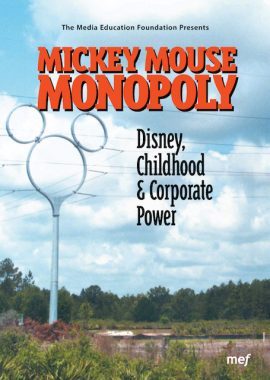





MICKEY MOUSE MONOPOLY:
DISNEY, CHILDHOOD, AND
CORPORATE POWER
A VIDEO BY CHYNG SUN &
MIGUEL PICKER
STUDY GUIDE
by Robert B. Pettit, Ph.D
Professor of Sociology
Manchester College
Sample
Syllabi: (MSWord97 format)
Robert B.
Pettit Syllabus, Manchester College
Martin
Schoenhals & Joseph Behar, Dowling College
The Walt Disney Company is a powerful force
in creating childhood culture all over the world. Presenting a worldview based
on innocence, magic, and fun, its products are endorsed by parents and
teachers, and are enthusiastically embraced by children.
*Behind
the images of innocence and fantasy, however, is a transnational media corporation owning media production companies,
studios, theme parks, television and radio networks, cable TV systems,
magazines, and internet sites. Disney is now one of the six or seven largest
media corporations that dominate control most of the mass media in the world.
*A
troubling question concerns the extent to which our view of the world may be
skewed by such a concentration of power in these corporations that mediate
images of our world to us, and the resulting impact on informed participation
in our democratic society.
*Disney's
impact is especially worrisome in view of its role as a major purveyor of the
stories that will be used to construct children's imaginary worlds as well as
their notions of the real world.
*Gender representations: The female characters in
Disney movies present a distorted version of femininity—highly sexualized
bodies, coy seductiveness, always needing to be rescued by a male. Snow White
cleans the dwarfs' cottage to ingratiate herself; Ariel gives up her voice in
order to win the prince with her body in The
Little Mermaid; Mulan almost single-handedly wins the war only to return
home to be romanced; and Beauty and the
Beast's Belle endures an abusive and violent Beast in order to redeem him.
*Representations of race and
ethnicity: Representations
of race and ethnicity in Disney animated features are notable for their general
scarcity, and when they do appear, they tend to reinforce cultural stereotypes
about these groups (for example, Latinos as irresponsible chihuahuas in Lady and the Tramp and Oliver and Company; African-Americans as
jive crows in Dumbo, as human-wannabe
orangutans in Jungle Book, and
totally absent in Tarzan's Africa;
Latinos and African-Americans as street-gang thugs in The Lion King; Asians as treacherous Siamese cats in Lady and the Tramp; Arabs as barbarians
in Aladdin; and Native Americans as
savages in Peter Pan and Pocahontas).
*Commercialization of children's
culture: The
stories Disney tells in its movies seem to be secondary to their being used as
vehicles for the merchandising of videos, toys, clothing, video games, etc.
Similarly problematic is the pervasive power of these Disneyfied versions of cultural
narratives to displace children's spontaneous creative play in favor of merely
replicating the ready-made Disney versions. Such commercialization should not
be surprising in light of Disney CEO Michael Eisner's pronouncement: "To
make money is our only objective."
Mickey Mouse Monopoly is a powerful and effective
documentary that owes its power and effectiveness to its unswerving and
persuasive marshalling of evidence and testimony to argue its case against
Disney. It is a good example of a "point of view" documentary, that
is, one that does not purport to present an "objective" or
"balanced" overview of all possible points of view regarding its
subject, but rather presents a clear and consistent point of view. Please note,
however, that "point of view" most assuredly does not mean biased or unfair, only that the
creators of and experts in this documentary are honest and straightforward in
making clear their value judgments as they critically examine Disney's power,
influence, and responsibility.
As a
teacher, you will probably face a variety of challenges in presenting such a
video to your students. On the one hand, there may be some students who will be
angered or defensive at the very thought of questioning such a sacred icon of
American culture and source of pleasant childhood memories as Disney surely is.
Your task in dealing with such students will be to encourage them to harness
their emotional reactions in the service of critical thinking—to set aside evaluation
in favor of understanding, to suspend judgment in favor of explanation. On the
other hand, there may be some students who, already antagonistic toward Disney,
will eagerly and unquestioningly embrace the arguments of the documentary,
thereby failing to subject those arguments to any critical scrutiny. Your task
in dealing with these students will be to challenge them to be open to
alternative readings of the evidence, and to articulate and examine the
unquestioned assumptions of their own arguments. (Of course, every teacher will
also be familiar with yet a third type of challenge—those students who resist
being engaged at all, who fail to register any passion on either side of the
questions raised! You're on your own here.)
The
task of this study guide, as I see it, is to confront both sides of this debate
with "inconvenient facts"—those facts which are dissonantly
inconvenient to any single-minded intellectual position. My belief is that the
point of any pedagogy is not simply to indoctrinate some "right
belief" (however strongly I myself may hold to that belief and find it
preferable to other beliefs), but to model and stimulate informed critical
thinking, to encourage students to become more comfortable with the enormous
complexity and ambiguity of the social world, even (perhaps especially) as they
stake out passionate positions.
Accordingly,
the format of this discussion guide will be a "Point/Counterpoint"
exchange. For each of the main points of the documentary, I will lay out the
documentary's strongest possible case for it, and also offer a strong and fair
alternative perspective (a sort of devil's advocate). Then I will pose some
questions for discussion, based on that exchange.
------------------------------------------------------------------------
A Point / Counterpoint
Exchange
with Questions for Discussion
Media Power
POINT: The thesis of this
documentary is that, as one of the six or seven largest media conglomerates in
the world, Disney has enormous power to shape our constructions of reality and
fantasy alike. The problem is that, as a private corporation, this power is
concentrated in the hands of a few who are neither elected nor accountable to
most of those affected by that power. More troubling still is the fact that
this power is directed primarily at those least able to resist it or critically
evaluate it—our children.
COUNTERPOINT: I can hardly disagree with
that. But why single out Disney? What about the other five or six global media
conglomerates, some of whom are even larger and more powerful than Disney? The
significance of Disney—its merits as well as its sins—can be evaluated only
within some context of comparison. Although we may all agree that Disney
messages fall short of what we would like to see in our children's culture, is
it fair to judge Disney without some context? We might also ask, Is Disney
better or worse than other animated movies over the past 70 years? Is Disney
better or worse than Max Fleischer, or Walter Lantz, or Warner Brothers, or
Hanna-Barbera, or UPA, or Don Bluth? How does the record of The Walt Disney
Company compare to other media conglomerates such as AOL/Time/Warner, or
General Electric/NBC/MSNBC, or Universal/Seagram's, or Bertelsmann, or Viacom,
or Rupert Murdoch's News Corporation? Why not examine the whole story?
POINT: I think you're missing the
point of making a documentary. Every
documentary undertaking is necessarily selective, and this one is no exception.
This documentary is a case study, an effort to expose this
worldwide, industry-wide problem through the critical examination of one
illustrative, well-known corporation. Be realistic—you can't very well survey
all these media giants in any useful detail in just one 50-minute documentary!
So why is Disney such an appropriate choice? Because (1) it is so recognizable
to the general public (just try marketing a documentary on Bertelsmann!). (2)
It is so identified with all things American that its lessons are more easily
generalized to other U.S. media giants. (3) Its targeting of our children as
profit centers should offend us more than any comparable marketing aimed at
adults. (4) Disney tries to hide its true motives beneath a cloak of innocence
and fantasy, to immunize itself against fair criticism, to the extent that it
understandably provokes the scrutiny of academics and others not so beholden to
the corporate world. Don't get too defensive here: The point is not so much to
attack Disney as to try to understand what types of stories get invented,
circulated, and perpetuated in the public imagination, and why.
COUNTERPOINT: O.K. I guess I can accept the
practical necessity of limiting your attention to Disney, based on your reasons
#1 and #2. But reasons #3 and especially #4 raise another issue. Are you
perhaps holding Disney to higher standards because of Disney's own
self-presentation as being "wholesome, innocent, family
entertainment"? That is, do you particularly resent what you perceive to
be its hypocrisy?
Isn't
this a bit moralistic? I mean, if Fox and Hanna-Barbera and Universal want to
market violent, sexist schlock to our kids but don't pretend they're out to do
anything but make a quick buck, should we hold them less accountable because of
their honesty?! At the end of your
documentary you quote Disney CEO Michael Eisner as saying that Disney has no
obligation to make history, art, or a statement, but simply to make money.
That's pretty aboveboard, isn't it? And isn't that the essence of corporate
capitalism? First you excoriate Disney for trying to hide its economic motives
and then you condemn it for admitting them. You can't have it both ways, can
you?
POINT: I'm glad you understood and
could accept reasons #1 and #2. I still think you're missing the point of #3
and #4. Don't you think the educators of our children should receive special
scrutiny? ? Shouldn't we hold anyone who
purports to teach our children to higher standards? Don't you think that
entertainment itself teaches cultural values and expected behaviors to our
children? Remember, it was Walt Disney himself who said, "We have long
held that the normal gap between what is generally regarded as 'entertainment'
and what is defined 'educational' represents and old and untenable
viewpoint" [p.44 in Walt Disney:
Famous Quotes, The Walt Disney Company, 1994]. In fact, through its
entertainment products Disney is making
a powerful and pervasive statement—about approved cultural narratives,
identities, and values.
QUESTIONS: Do you think this documentary
is fair in singling out Disney for special scrutiny? Do you think Disney is an
appropriate choice for examining corporate media power? Do you think other
media conglomerates are any better or any worse in what they teach our
children? Does it matter who is better or worse, or is the point just to
understand the very process of what is going on with regard to any media
conglomerate's influence on constructing reality and fantasy? In what ways are
the accusations against Disney unique to the case of Disney, and to what extent
are they generalizable to the very nature of corporate capitalism in the late
20th and early 21st centuries?
Anecdotal Evidence or
Scientific Research?
COUNTERPOINT: If I may be permitted to
bring up another point of contention….
POINT: Go ahead. Shoot.
COUNTERPOINT: The examples presented in
this documentary make no pretense of being representative of all Disney
products, nor even of the universe of Disney animated feature films. While they
may indeed be representative, the evidence is presented as anecdotal, not as a
quantitative content analysis. A fair question to raise, it seems to me, would
be whether a systematic quantitative content analysis would find the same
patterns to the same degree. Since perception is always selective, a fair
question is whether these examples selected to prove the theses of the
documentary may say more about the observers making the comments than they do
about Disney per se. Certainly,
conservative Christians who boycott Disney are critical of Disney as well, but
their reading of the texts is quite different from yours or mine, I think.
POINT: I think I'd agree with you
that the examples presented in this documentary make no pretense of being
representative of all Disney products, nor even of the universe of Disney
animated feature films. But again, I remind you that this is a 50-minute
documentary, not a lengthy scholarly dissertation. Hopefully, it will stimulate
the very sort of research you call for. Even so, your faith in
numbers-crunching content analysis may be greater than mine, I'm afraid. There
are subtleties and nuances of meaning which may be difficult to grasp simply by
counting and measuring. In the final analysis, the testimony of thoughtful and
informed experts is valid and valuable evidence in and of itself, in my
estimation.
COUNTERPOINT: I think we do have a
difference of opinion over the value of quantitative content analysis.
Certainly, qualitative analysis and commentary add texture and depth to
quantitative analysis, but to reject out of hand quantitative analysis—with its
attendant requirements of validity and reliability--leaves your experts'
opinions dangling as plausible hypotheses, not as sound empirical evidence.
QUESTIONS: How important do you think it
is whether the documentary has quantitative research to back up its
contentions? Are all the arguments presented amenable to scientific
verification, or are some of them value judgments? What other criteria might be
used to assess the validity of the arguments presented besides quantitative
content analysis?
Representations of Gender
COUNTERPOINT: If I might offer some
examples of what I referred to as "selective perception" in the
interpretation of Disney films…
POINT: Please do. That would help.
COUNTERPOINT: There are a number of
examples cited by the documentary's experts that I don't think are as
unambiguous in their meanings as you seem to think. For instance, some examples
cited of feminine seductiveness are understandable—the centaurettes in Fantasia, Thumper's bunny girlfriend in Bambi, Tinker Belle in Peter Pan, Jasmine in Aladdin. But you need also to admit that
there has been some progression in the portrayals of female characters over
time. Belle of Beauty and the Beast is
far more interested in reading books than in the overtures of the macho Gaston.
Pocahontas saves the life of Captain John Smith and averts a war, not by her
figure but by her words. Hercules' Megara was modeled on the strong female
stars of old Hollywood such as Barbara Stanwyck ("See ya 'round,
Herc!") and actually saves Hercules' life. The Hunchback of Notre Dame's Esmeralda is every bit a match for
Captain Phoebus in fencing and verbal repartee. Mulan saves the lives of
Captain Shang and the emperor, and proves herself a war hero. To read these
portrayals as unambiguously stereotypically feminine—weak and seductive—is to
ignore much disconfirming evidence, and to ignore that as society has changed,
so has Disney.
And
if I could add still some other interpretations regarding the complexities and
ambiguities of gender portrayals…. Ariel's giving up her voice to win her
prince in The Little Mermaid was
portrayed as an unwise bargain with the devil (Ursula) that almost turned out
disastrously, not as a strategy worthy of emulation. If Shang comes to visit
Mulan at the end of the film, it is because he is attracted to her strength and
independence. And Belle does not approve of or submit to the Beast's abuse or
violent rages—she refuses to eat or come out of her room; she is attracted to
his sweetness and kindness only after he begins to transform himself. The terms
of his curse require that he learn to love another and earn her love, an
explicit acknowledgment that it is he who must change his unforgivable
behavior. And it's also clear that Belle rejects the macho masculinity of
Gaston; in fact, his sexism and aggressiveness make him the villain of the
movie. Pocahontas and Esmeralda are both women who have political interests and
dare to intervene in the masculine realm of power to challenge injustice and
prejudice.
POINT: Sure, even as I reject your
interpretations here, I'll admit that there will always be some ambiguity in
textual interpretations (that's why we call them interpretations), but you are also ignoring the continuity
throughout these depictions (as well as in society, I might add). Every female
lead in Disney movies always has to be stereotypically beautiful—big breasts,
tiny waist, highly sexualized. Every one of them has to find love and romance
to be happy. And no matter how adventurous or empowered they may initially
seem, they always settle for traditional roles of security and domesticity in
the end. The male leads are always handsome, strong, and independent.
COUNTERPOINT: But isn't that true of fairy
tales and cultural ideals in general? You just mentioned the continuity of
gender stereotyping in the larger society.
POINT: My point is that, even if
there is disconfirming evidence (and I agree that we may never agree on textual
readings), there is still a continuity of gender stereotyping in our society
made even more pronounced by the caricaturing process of cartoon animation and
simplified scripting. And this is one of the ways—although surely not the only
way—that these cultural depictions get transmitted from generation to
generation. What also concerns me about Disney is its practice of regularly
re-releasing its "classic" movies to each successive generation. This
means that all kinds of outdated stereotyped portrayals—whether of gender,
race, ethnicity, whatever—get re-cycled to each new generation as if these were
accurate reflections of contemporary society, oblivious to all the
social-cultural changes that have happened since the first release of these
films. What might have been understandable if not excusable in the context of
the times of their original release now becomes a new offense. Every household
video library of Disney films contains a veritable archive of outdated and
offensive cultural stereotypes that parents do not even think to challenge
because they feel safe with Disney. Disney itself recognizes these offensive
characterizations as it regularly edits such offensive stereotypes from the
classic cartoon shorts shown on the Disney Channel, but no such practice exists
for editing classic animated feature films.
QUESTIONS: What examples of gender
stereotyping do you see in Disney films? Do you find gender stereotyping to be
more pronounced in the depictions of male or female characters, or do you see
any difference? Are your readings of gender portrayals closer to those of Point or Counterpoint? Can you cite examples from other Disney films or
products to support your view? Have gender portrayals in Disney films changed
over time? What evidence do you see for continuity or change in gender
portrayals? How do you think parents should handle outdated offensive
stereotypes that still exist in Disney films from earlier eras? How are gender
portrayals in Disney movies influenced by the fact that most Hollywood
executives (including Disney's) are white males?
Representations of Race and
Ethnicity
COUNTERPOINT: While we're on the subject of
stereotyping, may I raise the same sort of questions with regard to racial and
ethnic portrayals in Disney films?
POINT: I thought you might be headed
in that direction. What do you think of the documentary's arguments on this
issue?
COUNTERPOINT: My reaction is much the same
as it was with regard to its arguments about gender portrayals in Disney
movies. That is, the experts in the documentary seem to select only examples
that support their assertions while ignoring other examples quite to the contrary.
And even if I accept those particular examples, I don't think they are as
unambiguous in their meanings as those experts seem to think.
POINT: Can you please be more
specific?
COUNTERPOINT: Sure. Let's start with
Disney's depictions of blacks. I'll grant you, there have been plenty of racist
portrayals over the years—from the black centaurette shining hoofs in Fantasia (1940) right down to the total
absence of black Africans in Tarzan (1999).
But some depictions are not so simple. Take the black crows in Dumbo (1941). They are undeniably black,
but I don't think they're negatively portrayed. They are strong characters, not
stereotypes. They are witty, funny, and smart—it is they who devise and suggest
the "magic feather" stratagem to Timothy Mouse. They speak in a black
dialect, to be sure, but to criticize this fact is to criticize them on the
basis of their regional culture (theirs is a Southern black dialect) and their
class (their speech is assuredly not middle-class).
POINT: You're being altogether too
kind and generous in your interpretation, I think. Why is the lead crow named
"Jim Crow"?! How can an allusion to the reprehensible institution of
Jim Crow be seen as any kind of joke? And why does Cliff Edwards, a white man
who also did the voice of Jiminy Cricket, voice that character? You call that
an authentic black dialect? Why is it that no other characters in Dumbo speak with in any dialect—either
regional or class? They all speak in Standard English, and that serves to
marginalize the black crows into the status of outsiders. Where are the black
characters who don't speak in marginalized dialect?
COUNTERPOINT: Actually, other characters in
Dumbo do speak with accents—Timothy
Mouse with a working-class Brooklyn accent, and the ringmaster with a heavy
Italian accent. Timothy is certainly a heroic little character . . . but then
the ringmaster is a buffoon. So maybe it's a split decision?
POINT: More like 8-1, in my favor.
But back to Disney's depictions of blacks. What about those apes in The Jungle Book (1967) who want to be
like humans? Is the casting of black bandleader Louis Prima as their leader,
King Louis, merely a coincidence? Isn't that clearly a negative portrayal of
blacks when they are marginalized in casting and then given lines about wanting
to "be human, too"?
COUNTERPOINT: An unfortunate coincidence,
at the very least. I think the problem is not so much racial prejudice—a fear
and hatred of blacks, but institutional racism—the perpetuation of patterns of
inequality and exclusion that continues simply by everybody doing what they've
always done. If there had been many and varied black characters in Disney
films, this role would not stand out as racist. As it is, however, when you
have only one black actor in the film, and he sings a song about wanting to be
human like the others, the inescapable implication is racist.
POINT: So you agree with me?
COUNTERPOINT: I don't think I can help but
agree with you in this regard. But skip ahead a few years to The Aristocats (1970). Another black
musician, Scatman Crothers, is cast a Scat Cat, a hip jazz trumpeter in a band
of cat musicians. Their signature number is "Everybody Wants to be a
Cat," in which they sing, "Everybody wants to be a cat, because a
cat's the only cat who knows where it's at . . .. A cat's the only cat who
knows how to swing . . . . . Everybody digs a swinging cat." The message
here seems to be that being black (a cat) is cool, hip, and eminently
desirable—quite a contrast to the message about blackness in The Jungle Book. Maybe Disney was trying
to atone for its racist sins of three years before.
POINT: I doubt that, but I'll agree
that the implicit message is indeed improved over that of The Jungle Book. Can we skip ahead even further to take a look at The Lion King? This film was released in
1994, years after the initial cultural changes wrought by the civil rights
movement. How can you possibly excuse in this day and age the representation of
the villainous hyenas as racial and ethnic minorities speaking inner-city
street dialect? And casting African-American Whoopi Goldberg and Latino Cheech
Marin in those roles?
COUNTERPOINT: Again, you've got me. I don't
think I could excuse those choices. The best I could offer in explanation would
be that the inner-city street dialect perhaps betrays a class prejudice rather
than a specifically racial or ethnic prejudice, but I'll have to admit that's a
weak response. Perhaps even Disney itself did not want to have to defend these
portrayals again, considering that the hyenas did not appear in the
direct-to-video sequel, The Lion King II:
Simba's Pride. I would, however, hasten to point out the casting of
African-Americans in positive leading roles in The Lion King as well—James Earl Jones as Mufasa, Robert Guillaume
as Rafiki, and Niketa Calame as Young Nala. The fact that Mufasa and Young Nala
speak in Standard American accents (Rafiki speaks in a mixture of
Caribbean-accented English and Swahili phrases) may not make their race readily
apparent, but I say give Disney credit where credit is due. In some other
Disney films, African-American actors give voice to popular characters while
being recognizably black—Samuel E. Wright's Caribbean-accented Sebastian in The Little Mermaid and Eddie Murphy's
Mushu in Mulan. These are surely
positive developments, aren't they? And look at Hercules—there you have attractive and talented African-American
women singers serving as a sort of Greek chorus to narrate the movie. Isn't
that a positive portrayal?
POINT: A positive development one, yes,
but too little too late if you consider the fact that these were the first black women who appeared as black women in a Disney animated
feature film. And Disney has thus far never
portrayed an animated black man in its entire history of feature-length
animated films.
COUNTERPOINT: Point taken. Why don't we take a look at Disney's
portrayal of another ethic group?
POINT: O.K. I'd like to go back to
your citing that "Everybody Wants to be a Cat" sequence in The Aristocats. You neglected to mention
that this very scene also depicts a Siamese cat who plays the piano with
chopsticks, wears a cymbal as a "coolie" hat, is cross-eyed and
bucktoothed, has a maniacal laugh, and sings out, "Oh boy, ferras, ret's
rock this joint!" Quite a compilation of offensive stereotypical Asian
characteristics!
COUNTERPOINT: Again, you're right. It's an
offensive characterization. I suppose the most I could claim for that movie is
that its ethnic portrayals are mixed, with elements of both positive and
negative portrayals. That's all I'm saying—that Disney's record on this sort of
thing is mixed.
POINT: Mixed perhaps, but I don't
see the mixture as a balanced one. How
can you explain the continuity of this racist portrayal of Asians, going at
least back to Lady and the Tramp? The
Siamese cats there are given the same offensive stereotypical Asian
characteristics, plus they are depicted as sinister, cunning, manipulative, and
insidious, a sort of "Yellow Peril."
COUNTERPOINT: I certainly can't begin to
excuse such a portrayal, but perhaps I can try to explain it. Lady and the Tramp was released in 1955,
soon after the Korean War and in the midst of Cold War fear of China. The story
is set in turn-of-the-century America, a time when fears about Chinese
immigration were running high (as they come to Lady's home for a visit, the
Siamese cats sing, "Now we are looking over our new domicile / If we like
we stay for maybe quite a while"). The film is a reflection of its times,
for better or worse—and certainly worse in this regard. At least, as the video
points out, comparing these Siamese cats to Mulan, Disney has made very
significant improvements in the visual portrayal of Asians.
POINT: But, as the video also points
out, only at the expense of portraying China as an extremely oppressive and
sexist society. And, as for visual portrayals of Asians, the Mongols didn't
come off too well in Mulan. We need
to move on to other topics. Anything else on this one?
COUNTERPOINT: Did you know that Native
American activist Russell Means (also the voice of Powhatan in Pocahontas) described Pocahontas as "an important and
historic achievement for Hollywood and, I believe, the best and most
responsible film that has ever been made about American Indians"?
POINT: So? Native American activist
Winona LaDuke (also 2000 candidate for Vice-President on the Green Party ticket
with Ralph Nader) has called Pocahontas
a travesty against Native Americans and a distortion of their history.
COUNTERPOINT: Oh. One last thing. I think
the song sung by the gypsy Esmeralda, "God Help the Outcasts," in The Hunchback of Notre Dame, represents
a plea on behalf of all minorities—not only by ethnicity, but also by race,
class, gender, or sexual orientation:
God help the outcasts
Hungry from birth
Show them the mercy
They don't find on earth . .
.
I know so many
Less lucky than I
Please help my people
The poor and downtrod
I thought we all were
The children of God
God help the outcasts
Children of God
Considering
its timing, I think it might have been a jab at the homophobic religious right
who were organizing a boycott of Disney.
POINT: I think you may be right.
QUESTIONS: What examples of racial and
ethnic stereotyping do you see in Disney films? Do you find racial/ethnic
stereotyping to be more pronounced in the depictions of any particular minority
group, or do you see any differences? Are your readings of racial/ethnic
portrayals closer to those of Point or
Counterpoint? Can you cite examples
from other Disney films or products to support your view? Have racial/ethnic
portrayals in Disney films changed over time? What evidence do you see for
continuity or change in racial/ethnic portrayals? How do you think parents
should handle outdated offensive stereotypes that still exist in Disney films
from earlier eras? How are racial/ethnic portrayals in Disney movies influenced
by the fact that most Hollywood executives (including Disney's) are white
males?
Textual Analysis or Audience
Analysis?
COUNTERPOINT: May I raise one more point?
POINT: Why stop now?
COUNTERPOINT: I think we should remember
that textual analysis is not the same thing as audience analysis; that is, just
because a particular textual reading is valid, that is no assurance that all
audiences will read it as such or be affected in the ways we might think.
Audience effects are always an open empirical question, separate from textual
analysis of the content. There is in fact little empirical analysis of actual
audience effects of Disney products. Audiences are not dopes and can be very
creative in their receptions, perceptions, and reactions to mass media
messages. We still have to ask whether audiences in fact "learn" what
Disney is "teaching."
POINT: That's a valid point. I agree
that we should have more research on this point. But can't we expect there to
be some plausible correlation between media messages and audience reactions?
Until more research is available, I don't think this is an unwarranted
assumption. I mean, there's research already, for example, that shows that
people who are heavy television watchers not only have a worldview that
reflects their TV world, but also that their worldviews resemble one another's
regardless of class, race, gender, religion, or politics. Can't we generalize
from that? You also need to remember that, even if an individual rejects a
particular media message, that does not mean that individual is not affected by
that message. Media create a cultural environment we all have to live in, like
it or not. And one more thing—audiences may not be entirely "dopes,"
as you put it, but some are children, with less experience and developmental
ability to evaluate media messages. They are more likely to accept media
portrayals as valid if they have no experience to the contrary. Their critical
thinking skills are not yet developed. Any media corporation that targets
children as their favored demographic audience deserves special scrutiny.
COUNTERPOINT: But I think my point still
stands: the research is just not there on what are the actual effects of
watching Disney films. Maybe your expectations and generalizations are correct,
maybe not; we just don't have the evidence to settle this. There are so many
contextual factors that affect what people actually look at, what they actually
see, and what they actually remember—not to mention their developmental
level--that two different viewers may come away from watching the same movie
with very different interpretations—just
as you and I have—and then react quite differently to it. And I think
there's plenty of research that finds such things as social class, race, and
gender are far better predictors of people's attitudes and behaviors than their
TV viewing habits.
QUESTIONS: What does it mean to say that
textual analysis is not the same as audience analysis? Do you agree with this
statement? How might viewers creatively, even subversively, interpret messages
and portrayals in Disney films? Do children always replicate the stories they
see in films, TV, and videos, or do they ever juxtapose the characters and
story elements into narratives of their own making? What is the relationship
between the content of media messages and their reception by consumers? That
is, what factors may determine whether media messages are taken as gospel truth
or whether they are rejected as unrealistic fantasy? Are we also affected even
by messages we reject?
And In Conclusion . . .
POINT: Anything else?
COUNTERPOINT: Yeah. Do you really think
that Hercules was a "new
peak" in using a film to sell products, with its anachronistic urns, mugs,
and sneakers with Hercules symbols on them? The creators of that film certainly
knew those products were anachronisms—that was the joke! Wasn't it more of a
satirical commentary on the merchandising of celebrity? And wouldn't that make
it more subversive of commercialization rather than supportive of it?
POINT: Well, I agree that the movie Hercules tried to offer a satirical
commentary on the excesses of modern merchandising. But that didn't stop it
from being merchandised excessively and obscenely itself. Call it a postmodern
ironic sensibility if you wish, but the result was still the same—Disney winks
at itself while it commits the very outrages it is satirizing.
COUNTERPOINT: I'm going to Disney World.
Want to go with me?
POINT: I'm going to a Disney store to
protest Disney merchandise produced by Third World slave labor while Michael
Eisner gets obscenely excessive pay. Want to go with me?
COUNTERPOINT: Point, I think this is the
beginning of a beautiful friendship.
[Fade
to black]
QUESTIONS: How would you assess the
overall effectiveness of this documentary? Have you ever before considered the
points presented in this documentary? How do you think most people would react
to this documentary? Why does Disney arouse such passionate reactions, both pro
and con, in people? How do you think The Walt Disney Company would react to
this documentary? What steps toward media literacy can you think of that we
should teach children to help them critically evaluate Disney and other popular
culture products for themselves? Should this be taught in schools, even using
Disney as an object of study?
The production team of Mickey Mouse Monopoly is very interested
in your feedback and criticism. You
can reach them at: Let's Talk Media <letstalkmedia@aol.com>
Research
the extent of The Walt Disney Company's holdings and enterprises. An excellent
article in this regard may be found online:
McChesney,
Robert W. "The Global Media
Giants: The Nine Firms that Dominate the World," Extra! November/December 1997.
Were
you surprised at any of the company's holdings? In what ways is Disney
different from the other eight media giants profiled in this article? In what
ways is it similar? Are criticisms of Disney's global power equally applicable
to the other media giants, or is somehow Disney unique?
What
do you think are the consequences of this concentration of mass media into
fewer and fewer, larger and larger corporations? Take a look at another online
article by McChesney for his view:
McChesney,
Robert W. "Oligopoly: The Big
Media Game Has Fewer and Fewer Players," The
Progressive 1999.
GENDER REPRESENTATIONS IN DISNEY
FILMS
Collect
a sampling of videos of some of the most famous Disney animated feature films
spanning the decades from the 1930s to the present: e.g., Snow White and the Seven Dwarfs (1938), Pinocchio (1940), Dumbo (1941),
Bambi (1942), Cinderella (1950), Alice in
Wonderland (1951), Peter Pan (1953),
Lady and the Tramp (1955), Sleeping Beauty (1959), One Hundred and One Dalmatians (1961), The Sword in the Stone (1963), The Jungle Book (1967), The Aristocats (1970), Robin Hood (1973), The Rescuers (1977), The Fox
and the Hound (1981), The Black
Cauldron (1985), The Great Mouse
Detective (1986), Oliver and Company (1988),
The Little Mermaid (1989), The Rescuers Down Under (1990), Beauty and the Beast (1991), Aladdin (1992), The Lion King (1994), Pocahontas
(1995), The Hunchback of Notre Dame (1996),
Hercules (1997), Mulan (1998), Tarzan (1999),
The Emperor's New Groove (2000).
Probably you or members of your class own copies of at least some of these
videos, and they are also readily available for rental at video stores or for
borrowing at public libraries.
Assign
each selected film to a student or group of students. Ask them to watch the
film and keep a list of all characters in the film. Categorize each of the
characters listed by gender (if identifiable) and by whether it is a major or
minor role. Describe each of the characters, especially those in major roles,
according to some selection of the following traits:
* stereotypical masculine traits: achievement-oriented/ambitious,
self-reliant, self-confident, independent, responsible, decisive, rational,
dominant/aggressive/violent
* stereotypical feminine traits: obedient, submissive, dependent,
anxious to please, emotional, nurturing, affectionate, gentle, understanding,
sensitive, sacrificing, family-oriented, obsessed with physical appearance
Are
the major roles in Disney films given primarily to males or females? Has this
changed over time? Are the male and female characters in Disney films
stereotypically masculine and feminine in their traits and behaviors? Has this
changed over time? For the lead character in each film, what is his/her primary
goal or wish to be realized in the course of the film? Does this vary by
gender? Has this changed over time?
How
can you relate the gender depictions in Disney films over the years to the
changing roles of men and women in American society? How accurately have Disney
films reflected those changes?
THE ABSENCE OF WOMEN IN
MAKING DISNEY FILMS
Collect
a sampling of videos of some of the most famous Disney animated feature films
spanning the decades from the 1930s to the present (see list of suggested films
above).
Using
the slow-motion and freeze-frame functions of your VCR, examine carefully the
credits of your selected movies. How many names of women do you find among the major credits—i.e., directors,
producers, executive producers, story and screenplay writers, and supervising
animators? Count all the names listed and calculate what percentage of all major credits lists female names. Do the numbers
and percentages vary over the years? Why do you think this is? Is this
minuscule representation of women in Disney animated features merely an
unconscious reflection of the times in which the films were made, or was Disney
conscious of its exclusion of women? [Animator ward Kimball recalls that the
employment ad that brought him to Disney Studios in the 1930s specified
"male artists"!]
What
effect do you think this relative absence of women in major credited capacities
had on the stories and characters of Disney films? Do these films therefore
reflect a specifically masculine sensibility
and neglect a specifically feminine sensibility?
Are the portrayals of female characters more stereotypical than the depictions
of male characters? Be prepared to cite specific examples to support your
conclusions. [Note that the first Disney animated feature to receive praise for
its stronger female lead was Beauty and
the Beast (1991), and that this was also the first Disney animated feature
to be scripted by a woman—Linda Woolverton.]
REPRESENTATIONS OF RACE AND
ETHNICITY IN DISNEY FILMS
Collect
a sampling of videos of some of the most famous Disney animated feature films
spanning the decades from the 1930s to the present (see list of suggested films
above).
Assign
each selected film to a student or group of students. Ask them to watch the
film and keep a list of all characters in the film. Categorize each of the
characters listed according to these characteristics: race/ethnicity (if
identifiable), major or minor role, and positive/sympathetic or
negative/unsympathetic portrayal.
What
conclusions can you draw from your content analysis? What racial/ethnic groups
are most frequently portrayed in these films? What is the racial/ethnic
identity of the major sympathetic characters? What is the racial/ethnic
identity of the major unsympathetic characters? What characteristics seem to be
associated with each identifiable racial/ethnic characterization? [If the
race/ethnicity of any characters are not easily identifiable, do you think they
are nonetheless portrayed in the mold of white Americans—e.g., no identifiable
accent / standard American accent, middle-class American values, etc.?] Do you
notice any changes in these portrayals over the years? How can you relate the
racial and ethnic depictions in Disney films over the years to the changing
attitudes toward race relations and ethnic diversity in American society? How
accurately have Disney films reflected those changes?
DISNEY ANIMATED FILMS IN THE
CONTEXT OF CINEMATIC HISTORY
Try
to obtain video copies of some major animated features from non-Disney sources,
spanning the decades from the 1930s to the present: e.g., Gulliver's Travels (Max Fleischer, 1939), Mr. Bug Goes to Town (re-titled Hoppity
Goes to Town; Max Fleischer, 1941), Raggedy
Ann and Raggedy Andy—A Musical Adventure (Richard Williams, 1977), The Last Unicorn (Rankin-Bass, 1982), The Secret of NIMH (Bluth, 1982), The Care Bears Movie (Nelvana Studios /
American Greetings, 1985), An American
Tale (Bluth / Spielberg's Amblin Productions, 1986), The Land Before Time series (Sullivan & Bluth / Spielberg &
Lucas, beginning in 1988), All Dogs Go to
Heaven (Sullivan & Bluth, 1989), Kiki's
Delivery Service (Japanese, 1989), Rock-A-Doodle
(Sullivan & Bluth, 1990), The Swan
Princess (Rich Animation Studios / Columbia TriStar, 1994), Thumbelina (Bluth & Goldman /
Warner, 1994), Anastasia (Bluth &
Goldman / Fox, 1997), Cats Don't Dance (Turner
Feature Animation , 1997), The King and I
(Rich Animation Studios / Rankin-Bass / Warner, 1999).
Pair
each non-Disney film you have selected with a Disney film of approximately the
same year of release. Assign each selected film pair to a student or group of
students. Subject each selected film to the same analysis as suggested for Disney
films in the exercises above (regarding representations of gender, credited
female contributors, racial and ethnic representations).
Regarding
their representations of gender, race, and ethnicity, in what ways are Disney
and non-Disney animated films similar? In what ways are they dissimilar? Is
Disney unique in its portrayals, or are these portrayals reflective of cultural
stereotypes that pervade all cultural products? Again with regard to these
portrayals of gender, race, and ethnicity, would you consider Disney films to
be better, worse, or no different from other studios' films over the years?
Cite examples from the films analyzed to support your evaluation.
To
what extent are Disney and other producers of mass culture responsible for
creating, disseminating, and sustaining these stereotypes, and to what extent
do they simply reflect deeper social, cultural, political, and economic
realities neither of their making nor particularly subject to their influence?
CHALLENGES TO DISNEY
Giroux
outlines a strategy for addressing the formidable presence and influence of
Disney in American life ("Are Disney Movies Good for Your Kids?" pp.
53-67 in Shirley R. Steinberg and Joe L. Kincheloe, editors, Kinderculture: The Corporate Construction of
Childhood, Boulder, CO: Westview Press, 1997):
1. Schools should study popular culture
as a serious object of social knowledge and critical analysis.
2. Parents, educators, and community
groups must challenge and re-write popular culture's messages about family
values, history, and national identity.
3. In order to be fully grasped, Disney's
influence must be analyzed within a larger historical, social, political, and
economic context.
4. Parents, educators, and cultural
analysts must develop new forms of literacy for understanding electronically
produced visual media and be attentive to the diverse ways different groups of
kids "read" these media.
5. Disney's public responsibilities
extend beyond those of its role as entertainer to include its role as educator
of the young; accordingly, Disney must be challenged and held accountable not
only in economic terms, but also in political and ethical terms.
A
very different challenge to Disney and attempt to hold it accountable in
economic, political, and ethical terms, is the boycott of all things Disney
spearheaded by the Southern Baptist Convention, the American Family
Association, Operation Rescue, and other religious-right groups (see the Official Disney Boycott website).
What,
if anything, do these two challenges to Disney have in common? Compare their
professed reasons for challenging Disney, as well as their tactics. Why does
Disney draw such fire from both sides of the political spectrum? What do you
think should be the proper response, if any, to Disney's perceived offenses?
Allan,
Robin (1999). Walt Disney and Europe: European Influences on the Animated
Feature Films of Walt Disney. Bloomington,
IN: Indiana University Press.
Detailed
scholarly study of the ways European culture influenced Disney in the making of
classic animated features.
Bell,
Elizabeth, Lynda Haas, and Laura Sells (1995). From Mouse to Mermaid: The
Politics of Film, Gender, and Culture. Bloomington,
IN: Indiana University Press.
Essays
addressing the Disney film legacy from feminist, Marxist, and other critical
perspectives. Special attention to issues of gender, race, and class.
Bryman,
Alan (1995). Disney and His Worlds. London: Routledge.
The
best single overview of the scholarly literature on Disney, covering Disney the
man, the company, the films, and the theme parks. Addresses issues as diverse
as the organizational structure of the corporation with and without Walt, and
the theme parks as sites of consumption, tourism, and postmodernism.
Byrne,
Eleanor and Martin McQuillan (1999). Deconstructing Disney. London: Pluto
Press.
This
revisionist leftist book questions traditional exposés of Disney's racism,
sexism, cultural imperialism, etc. by arguing that the historical, social, and
political context of Disney texts has so changed that so must the task of
deconstruction. In the words of the authors, " Quasimodo is not Pinocchio
and Pocahontas is not Snow White."
Dorfman,
Ariel and A. Mattelart (1975). How to Read Donald Duck: Imperialist Ideology in
the Disney Comic. New York:
International General.
Chilean
Marxist dissects the imperialist messages embedded in Disney comics (P.S.
They're not the same comics you and I
were given to read in the U.S.).
Eliot,
Marc (1993). Walt Disney: Hollywood's Dark Prince. New York: Birch Lane.
A
biographical "exposé" of Walt Disney, summarizing a host of
uncomplimentary facts and dubious rumors about Uncle Walt—his psychosexual
obsessions and neuroses, his anti-Semitism and anti-Communism, his inadequacies
as a family man, and his anti-labor management style.
Fjellman,
Stephen M. (1992) Vinyl Leaves: Walt Disney World and America. Boulder, CO:
Westview Press.
An
anthropologist examines lands and attractions of Disney World in extensive
detail, locating them in a larger social-cultural context.
Flower,
Joe (1991). Prince of the Magic Kingdom: Michael Eisner and the Re-Making of
Disney. New York: John Wiley.
Business
biography of Eisner.
Frantz,
Douglas and Catherine Collins (1999). Celebration, U.S.A.: Living in Disney's
Brave New Town. New York: Henry Holt.
A
husband-and-wife team (he's a reporter for The
New York Times, she's a free-lance journalist and full-time mom) who, with
their two school-age children, lived for two years in Disney's bold experiment
in community-building, its new town of Celebration.
Giroux,
Henry (1999). The Mouse that Roared: Disney and the End of Innocence. Lanham,
MD: Rowman and Littlefield.
Giroux
(featured in Mickey Mouse Monopoly)
attacks Disney for its attempts to hide beneath a cloak of innocence and magic
even as it teaches children deeply conservative values and treats them
primarily as consumers.
Griffin,
Sean (2000). Tinker Belles and Evil Queens: The Walt Disney Company from the
Inside Out. New York: New York University Press.
Although
Disney has long been identified with conservative family values, Griffin traces
the contributions of gays within the corporation and their resulting influence
on mainstream American culture.
Grover,
Ron (1991). The Disney Touch: How a Daring Management Team Revived an
Entertainment Empire. Homewood, IL: Irwin.
Business Week journalist
Grover examines the rescue of the Disney corporation by the
Eisner/Wells/Katzenberg management team.
Hiaasen,
Carl (1998). Team Rodent: How Disney Devours the World. New York: Ballantine.
Amusing
muckraking monograph by journalist who is a lifelong Florida resident and now
disgruntled Disney neighbor. Writes Hiaasen, "Disney is so good at being
good that it manifests an evil: so uniformly efficient and courteous, so
dependably clean and conscientious, so unfailingly entertaining that it's
unreal, and its therefore an agent of pure wickedness."
Lainsbury,
Andrew (2000). Once Upon an American Dream: The Story of Euro Disneyland.
Lawrence, KS: University Press of Kansas.
Lainsbury,
who holds a Ph.D. in American studies and once worked at Euro Disney, examines
Europe's love/hate relationship with Euro Disney within the context of cultural
imperialism and global corporatism.
Maltin,
Leonard (2000). The Disney Films (4th
ed.). New York: Hyperion.
The
definitive comprehensive guide to all Disney films, both animated and
live-action, both features and shorts. Included are plot summaries, production
credits, and critical commentaries, as well as interviews with Disney staff
members.
_____
(1990). Of Mice and Magic: A History of American Animated Cartoons (rev. ed.).
New York: New American Library.
Like
the subtitle says, a comprehensive history of animated cartoons in America.
Useful in locating Disney within the context of other studios and their
products.
McChesney,
Robert W. (1999). Rich Media, Poor Democracy: Communication Politics in Dubious
Times. Urbana, IL: University of Illinois Press.
Media
historian McChesney examines the growing corporate control of media and how it
contributes to the decline of democratic participation. While not about Disney
alone, this book traces the developments that have characterized The Walt
Disney Company as well as other global media conglomerates.
Mickey
Mouse Goes to Haiti: Walt Disney and the Science of Exploitation (1996). 17
min. National Labor Committee, 275 7th Ave., 15th Floor, NY, NY 10001. www.nlcnet.org. 212-242-3002.
Interviews
with Haitian workers who sew Disney children's clothing for sale in the U.S.
describe their starvation wages and oppressive factory working conditions.
Project
on Disney, The (1995). Inside the Mouse: Work and Play at Disney World. Durham,
NC: Duke University Press.
Blending
personal meditations, interviews, photographs, and cultural analysis, the
authors offer an alternative take on why Disney World embodies the American
leisure experience. Best chapter: "Working at the Rat," drawn from
interviews with Disney World cast members.
Raz,
Aviad E. (1999). Riding the Black Ship: Japan and Tokyo Disneyland. Cambridge,
MA: Harvard University Asia Center and Harvard University Press.
Sociologist
Raz looks at how Tokyo Disneyland is experienced by its employees, management,
and visitors, providing an ethnographic account from the Japanese point of view.
Contrary to previous critiques characterizing Tokyo Disneyland as an outpost of
American cultural imperialism, Raz argues that its success has been due to its
becoming Japanese while marketing itself as foreign.
Ross,
Andrew (1999). The Celebration Chronicles: Life, Liberty, and the Pursuit of
Property Value in Disney's New Town. New York: Ballantine.
Based
on his living in Celebration for a year and his interviews with fellow
residents, employees, and Osceola County locals, Ross asks: What does Celebration
reveal about contemporary culture? Is this model town a cause for celebration
or alarm? Can we entrust the public interest to giant beneficiaries of the
marketplace like Disney?
Schickel,
Richard (1997). The Disney Version: The Life, Times, Art and Commerce of Walt
Disney (3rd edition). Chicago: Ivan R. Dee.
One
of the best critical biographies of Walt Disney—his life, his work, and his
influence on American popular culture, by Time
magazine film critic.
Schweizer,
Peter and Rochelle Schweizer (1998). Disney: The Mouse Betrayed: Greed,
Corruption, and Children at Risk. Washington,
DC: Regnery.
Detailed
right-wing hatchet job on Disney, implicating it in pornography, pedophilia,
Satanism, pandering to Chinese Communism, and promoting "the gay agenda."
How they missed Disney's sordid roles in the heartbreak of psoriasis and the
assassination of the Kennedys, I just don't know.
Smoodin,
Eric, ed. (1994). Disney Discourse: Producing the Magic Kingdom. New York:
Routledge.
An
American Film Institute reader. Includes essays from humanities and
social-scientific perspectives that both celebrate and critically examine the
contributions and global impact of Disney.
Steinberg,
Shirley R. and Joe L. Kincheloe, eds. (1997). Kinderculture: The Corporate Construction
of Childhood. Boulder, CO: Westview Press.
Essays
examining the corporate construction and manipulation of childhood culture in
pursuit of corporate profit. Includes a chapter by Henry A. Giroux, "Are
Disney Movies Good for Your Kids?"
Thomas,
Bob (1976). Walt Disney: An American Original. New York: Simon & Schuster.
The
authorized biography of Walt Disney, by an Associated Press entertainment
reporter, presenting the "official" version of Disney as the Disney
Company likes to portray him. Full of hagiographic anecdotes.
Wallace,
Mike (1996). Mickey Mouse History and Other Essays on American Memory.
Philadelphia: Temple University Press.
A
historian looks at the Disneyfication of American history. The two relevant
chapters are " Mickey Mouse History: Portraying the Past at Disney
World" (pp. 133-157) and "Disney's America" (pp. 159-174).
Watts,
Steven (1997). The Magic Kingdom : Walt Disney and the American Way of Life. New York: Houghton Mifflin.
Undoubtedly
the most comprehensive, thoughtful, and balanced biography of Walt Disney, by a
respected historian of American culture.